Product Design
Young Fintech Mobile App
A mobile fintech app designed to help teens aged 11–17 build healthy saving habits through clear goals, engaging visuals, and smart guidance.

Project Overview
Introducing the Project
A mobile fintech app designed to help teens aged 11–17 build healthy saving habits through clear goals, engaging visuals, and smart guidance.
Role
Product Designer
Duration
40 hours - Challenge
Tools
Chat GPT, Figma, Figjam, Figma Slides
Problem Statement
What problem are we solving?
Every design decision in this project flows from a clearly defined problem. Without this anchor, features become guesswork.
Context
Financial literacy among teenagers is a growing concern. Most young people aged 11–17 lack the tools to manage even small amounts of money effectively not because they don't want to save, but because no product speaks their language.
Problem
Existing savings apps are designed for adults. Teen-focused alternatives exist but are either too simplistic, or rely on parental control in a way that removes the teen's sense of ownership and motivation to engage.
How Might We
Financial literacy among teenagers is a growing concern. Most young people aged 11–17 lack the tools to manage even small amounts of money effectively not because they don't want to save, but because no product speaks their language.
Role & Constraints
Context of this project
Naming constraints isn't a weakness it's how designers show they understand the difference between ideal process and real conditions.
Time constraint
~40 hours total over approximately one week as a solo design challenge.
No real user access
All research is desk-based. Personas are hypothesis-driven, validated against secondary sources.
Solo designer
I owned all decisions end-to-end from research framing to high-fidelity mockups.
Scoped brief
Focus on the saving experience. Onboarding, account management, and security are out of scope.
Given the time constraint, I prioritized breadth over depth in research and validated design decisions through competitive benchmarking rather than user interviews. If this were a real product, the next step would be recruiting teen participants for moderated usability testing.
User Research
Understanding the users
During the user research analysis, I focused on the target audience. Although the age range is quite narrow, there are different needs and pain points related to this kind of application. The first insight is that the functionality must be highly customizable to align with the user’s goals
This way, the different target users within the target range can use the same application for different purposes. Therefore, I hypothesize two buyer personas, each belonging to different needs clusters.
Personas

Lucy Smith
12 years old
Goals
- Saving money for small personal purchases such as toys, video games, or clothes;
- Being able to track one's savings easily and enjoyably.
Pains
- Lack of tools to clearly see how much is being saved
- Tendency to spend allowance money immediately without realizing how quickly it runs out.

Marcelo Herrera
17 years old
Goals
- Saving for future projects such as a trip or buying a scooter/car;
- Learning to better manage personal finances.
Pains
- He loses track of small daily expenses, struggling to achieve his savings goals;
- He wants to prove that he is independent and that his money is enough to cover everything.
Emphaty Map
Lucy Smith
Thinks and Feels
- Saving money is difficult, but she would like to set aside her own money;
- She feels grown-up and wants to start spending on her own
Hears
- Her parents tell her not to waste money.
- Her friends discuss what they want to buy.
Sees
- She sees her friends buying things she would like;
- She sees social ads for toys or products that she would like to buy.
Says and Does
- She often asks her parents for money for small purchases.
- She talks with friends about their purchases, games, and clothes.
Marcelo Herrera
Thinks and Feels
- He wants to be financially independent and save for long-term goals.
- He believes that managing money is important for his future.
Hears
- Parents tell him to save for the future.
- Friends discuss important trips or buying a scooter/car
Sees
- He sees some friends managing expenses and savings responsibly.
- He sees their peers spending impulsively and would like to do better.
Says and Does
- He talks with friends about part-time job opportunities and saving.
- He frequently checks his account to see if he can save money.
Competitive Analysis
Exploring the market
After analyzing the target, I moved on to a market analysis to identify any existing Fintech solutions that could address the identified needs. I then highlighted the main features of these solutions to benchmark savings apps for young people.
I found the following situation inside the market:
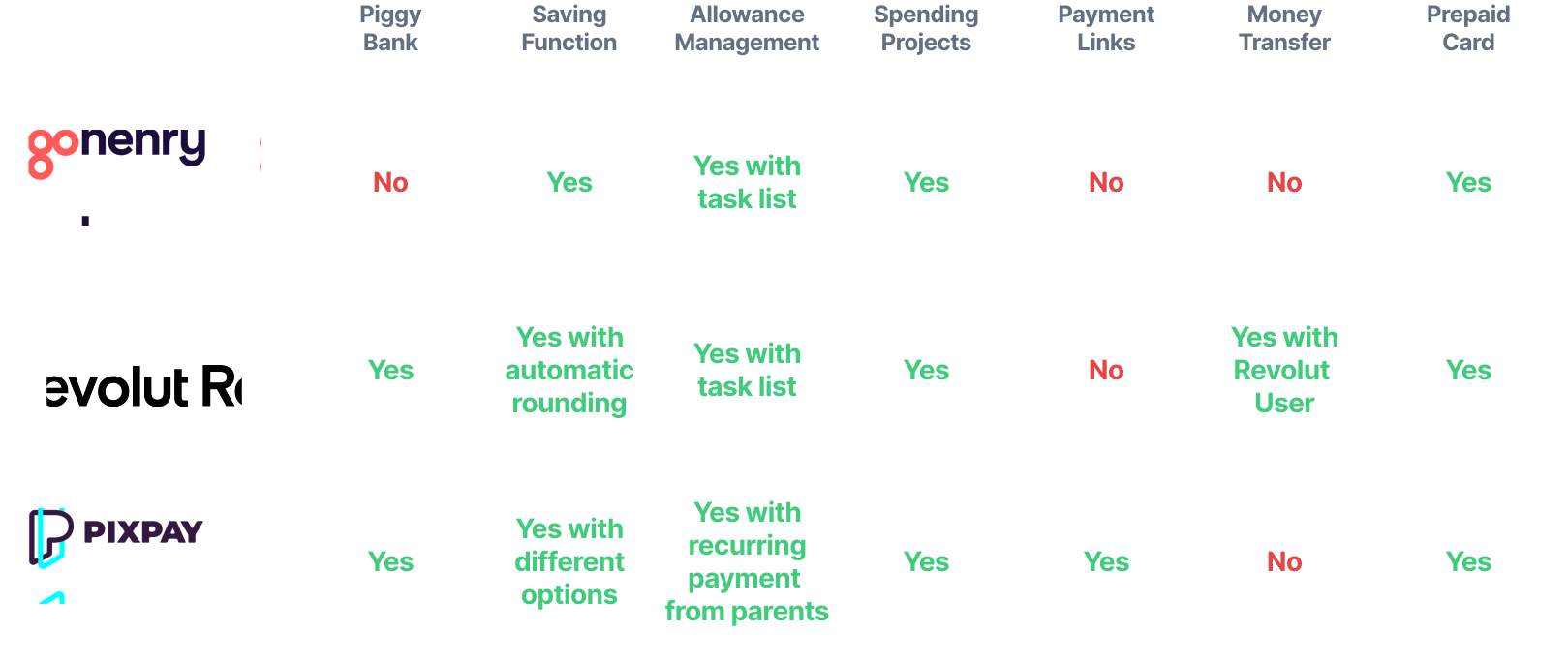
3 gaps identified
1
No real dual-user experience
Apps are either teen-driven or parent-controlled. None offer a balanced collaborative model where both parties have genuine agency.
2
Goal visualization is weak
Apps show numbers, not stories. Teens respond to visual metaphors progress bars, countdowns — not raw financial data.
3
Allowance is transactional, not educational
No app connects earning to saving in a way that builds real financial understanding over time.
Synthesis
From insights to decisions
Each feature exists because a specific research insight demanded it. This is the bridge between data and design.
Research Insight
Teens save more when they have a concrete, visual goal not an abstract "save for the future"
User Need
See progress toward a specific, self-chosen target
Feature
Spending Projects
Research Insight
Short feedback loops matter teens need to feel money "working" even passively over time
User Need
Passive reward for money left in savings
Feature
Piggy Bank
Research Insight
The feeling of independence is crucial money earned through effort feels more owned
User Need
Earn allowance through tasks, not passive receipt
Feature
Teen Allowance
Ideation
Defining the idea
After analyzing the current market solutions, some features consistently emerge in savings management applications.
Beyond their specific interfaces, most of these products share similar patterns in how users set goals, track progress, and receive motivation over time.
This analysis helped identify the most relevant functionalities and guided the definition of what features could best fit our users’ needs.
The functionalities are the following:
Spending Projects
Savings projects with deadline and target. Fully user-defined, versatile across all ages.
Driven by Lucy's need for short-term visual goals and the market gap in goal visualization.
Saving Functions
No deadline, no target. Money earns monthly interest set by parents encouraging long-term retention.
Driven by Marcelo's need to grow money passively and the gap in teen interest mechanics.
Allowance
Parents create tasks, teens complete them to earn. Scales across the full 11–17 age range.
Driven by both personas' need for ownership and the gap in educational allowance mechanics.
Design sketches
I used pen and paper to create some sketches of application as a guide for wireframe

Visualizing with wireframes
Then I created the Hi-Fi version of the wireframe to streamline the transition to mockups


Information Architecture
How the app is structured
With three features and two user types, mapping the architecture was essential before moving to screens.

Design Gap Acknowledged:
The Parent View requires a dedicated design sprint. It's out of scope for this challenge but deliberately named here, because ignoring a second user type would be a product design failure, not just a time constraint.
Solution
Designing the solution
Given the different needs of the users within the target audience and the complexity of financial topics at such a young age, I decided to divide the main "Saving money" feature into three distinct micro-features.
#
"Project" functionality
Driven by: Lucy's need for short-term concrete goals and the gap in visual goal-tracking.
The Project feature allows the user to create multiple savings projects with a set deadline (such as buying a new video game, a scooter, or a trip).
The size of the project is determined by the target user, making the feature completely versatile.
Project's functionality Userflow
The proposed user flow for this feature is the following:

Project's Screens
The following mockups illustrate how this flow translates into the interface:


#
"Piggy Bank" functionality
Driven by: Marcelo's desire to grow money over time and the gap in passive saving incentives for teens.
The Piggy Bank function allows the user to save money for their future.
Unlike the Project function, the Piggy Bank does not have a deadline or a target to reach. For this reason, the money deposited in the piggy bank will earn a monthly interest based on the total amount and set by the user's parents.
Through these features, the user is encouraged to deposit money frequently and leave it in the piggy bank for as long as possible.
Piggy Bank's functionality Userflow
The proposed user flow for this feature is the following:

Piggy Bank's Screens
The following mockups illustrate how this flow translates into the interface:


#
"Teen Allowance" functionality
Driven by: both personas' need to feel ownership over money, and the parent's need to stay involved without being controlling.
The Allowance feature allows the user to redeem their allowance by completing a list of tasks.
Tasks are added by parents, who assign the corresponding value.
Depending on the target audience, there will be tasks of varying difficulty, allowing the feature to be used by the entire target audience.
Teen Allowance's functionality Userflow
The proposed user flow for this feature is the following:

Teen Allowance's Screens
The following mockups illustrate how this flow translates into the interface:


Testing Strategy
What I would test next
No usability testing was conducted due to challenge constraints. Here's exactly how I would approach validation before development.
Round 1 — Concept Validation
Before wireframes
- 5 moderated interviews with teens aged 12–17 to validate the three-feature model
- 3 interviews with parents on comfort with the interest-rate setting feature
- Key question: does separating Projects / Piggy Bank / Allowance feel natural?
Round 2 — Usability Testing
On hi-fi prototype
- Unmoderated test on "Create a Project" flow with 8 participants
- Task: "Create a savings project to buy sneakers in 3 months"
- Success metric: completion rate >80%, time on task <90s
Key hypothesis to validate:
The biggest design risk is the Piggy Bank interest mechanic it introduces a financial concept that may be opaque to younger users (11–13). I would specifically test comprehension with Lucy-type users before committing to the current implementation.
Learnings
Retrospective
What worked, what I'd do differently, and the one thing I'll carry forward.
What worked
Breaking "saving" into three micro-features served two very different profiles without compromise
User flow → mockup pairing made reasoning about each feature in isolation much clearer
Competitive analysis surfaced the dual-user gap early which became the central design challenge
What I'd do differently
Involve the parent experience from the start it's a primary actor, not an afterthought
Define the problem statement before building personas, not after
Design the empty/onboarding state the first-launch moment is the most critical screen I left undesigned
The main takeaway
"Designing for teens is not about making things cute it's about respecting their intelligence while meeting them at their level of financial experience. The biggest risk is underestimating Marcelo as much as overcomplicating things for Lucy."
Great design starts
with a conversation
30 minutes. No commitment. We'll figure out together if I can actually help.
© 2026 - Built with 🧡 by Daniele